

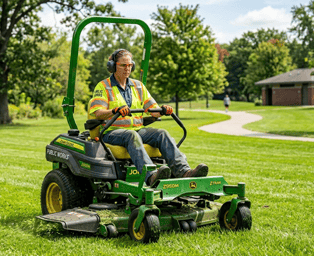
 Spring brings increased outdoor operations that may expose workers to excessive noise from lawn mowers, string trimmers, leaf blowers and other powered equipment. Lawn mowers typically produce noise levels between 85–100 decibels (dB) - loud enough to harm hearing after prolonged or repeated exposure. The Center for Disease Control (CDC) estimates that 22 million workers are exposed to potentially damaging noise at work each year. In response, the National Institute for Occupational Safety and Health (NIOSH) has established a recommended exposure limit (REL) of 85 A-weighted decibels (dBA) averaged over a typical eight-hour workday. Employees exposed to noise at or above the NIOSH REL risk developing significant hearing loss over their working lifetime. Hearing loss happens gradually and is irreversible, making prevention essential.
Often it is challenging for employers to apply engineering controls to muffle the noise of mowers and outdoor power equipment. As a result, personal protective equipment (PPE) becomes the first line defense to ensure hearing preservation.
A simple way to determine whether hearing protection is required while lawn mowing or operating other outdoor power equipment is when noise levels are high enough that it requires a worker to raise their voice to communicate with someone at arm’s length.
Potential Consequences of Not Using Hearing Protection
- Permanent hearing loss.
- Ringing or buzzing in the ears (tinnitus).
- Increased fatigue and reduced situational awareness.
- Communication difficulties that may increase injury risk.
 Selecting Appropriate Hearing Protection
- Wear ANSI/ASA S12.6 (current edition) approved hearing protection when operating lawn mowers or similar equipment.
To determine noise level reduction:
- Obtain the employee's A-weighted time-weighted average TWA noise exposure.
- Subtract 7 dB from the hearing protection NRR and subtract the result from the A-weighted TWA to obtain the estimated A-weighted TWA under the ear protector.
Source: 29 CFR 1910.95; Appendix B: Methods for Estimating the Adequacy of Hearing Protection Attenuation.
- Select earmuffs or earplugs with a Noise Reduction Rating (NRR) sufficient to reduce exposure to below 85 dBA. For example, if the lawn mower has an operating noise level of 100 dBA hearing protection should be selected that reduces dBA by 15 or greater. Note: The noise reduction provided by a hearing attenuator is not directly proportional to the NRR. See text box for one option to determine the actual noise level reduction created by the hearing protection.
- Ensure hearing protection is worn consistently for the duration of exposure.
- Inspect earmuffs/earplugs regularly to ensure proper fit and seal.
- In-ear hearing protectors (ear plugs) typically offer better hearing protection but must be inserted properly into the ear canal to ensure optimal noise attenuation. Over-the-ear hearing protectors (ear muffs) are less effective because it is more difficult to seal out noise when using ear muffs due to seal interference from beard stubble, long hair, eye glasses, etc.
- Consider using hearing protection with integrated communications capabilities like those made by: Sonetics, Peltor, or others. Having clear communications will increase worker safety and operational efficiency.
Training and Responsibilities
It is expected that all employees exposed to hazardous noise levels be trained to recognize noise hazards, how to properly wear hearing protection and understand the long-term consequences of unprotected noise exposure. It is the responsibility of the employer to provide PPE that is appropriate for the tasks being performed. Consider these factors to improve hearing protection selection: comfort, compatibility, convenience, communication and cost. Protect against hazardous noise today to ensure you can hear pleasant sounds tomorrow!
References
Hearing Protectors - NIDCD, www.nidcd.nih.gov/sites/default/files/documents/health/hearingprotectors.pdf. Accessed 20 Apr. 2026.
“Noise-Induced Hearing Loss.” Centers for Disease Control and Prevention, Centers for Disease Control and Prevention, www.cdc.gov/niosh/noise/about/noise.html. Accessed 20 Apr. 2026.
“Occupational Noise Exposure - Overview.” Occupational Safety and Health Administration, www.osha.gov/noise. Accessed 20 Apr. 2026.
“Provide Hearing Protection.” Centers for Disease Control and Prevention, Centers for Disease Control and Prevention, www.cdc.gov/niosh/noise/prevent/ppe.html. Accessed 20 Apr. 2026.
Safety and Health, www.fs.usda.gov/t-d/pubs/pdfpubs/pdf10672321/pdf10672321dpi72.pdf. Accessed 20 Apr. 2026.