

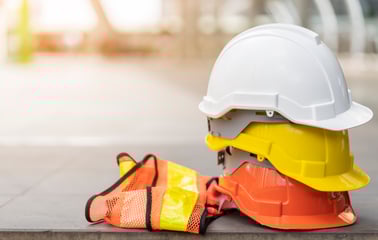
 In 2020, the Bureau of Labor Statistics reported head injuries accounted for nearly 6 percent of non-fatal occupational injuries involving days away from work. Almost half of those injuries occurred when workers came in contact with an object or equipment while about 20 percent were caused by slips, trips and falls.1
During 2021-2022, some of the top causes of days away from work were:
- Falls, slips and trips - 450,540 cases
- Contact with objects and equipment - 450,050 cases.2
An average of 364 U.S. construction workers died annually from slips, trips, or falls between 2017 and 2021.3 One of the most serious types of injuries that can result from falling objects and equipment or slips, trips, and falls is Traumatic Brain Injury (TBI). TBI occurs when the brain experiences an external force, such as a forceful blow to the head or an object penetrating the skull and reaching the brain. This type of head injury can range from mild (concussion) to severe, with resulting effects ranging from temporary to permanent. TBIs are also associated with causing a wide range of physical, cognitive, and emotional/behavioral problems.
Thankfully, there is a way to mitigate occupational head injury risk. Safety helmets are recommended for those working in industries where head injuries are a concern. This includes public entities who perform construction, road work, tree maintenance and utility operations. Concussions are often linked to rotational forces applied to the brain during angled impacts. A recent innovation in head protection is a feature called Multi-Directional Impact Protection System (MIPS for short). MIPS is designed to redirect rotational forces associated with impacts, potentially reducing the risk and severity of concussions. Certain Type 2 helmet manufacturers have adopted this new MIPS system which is lighter than earlier foam padded Type 2 helmets (think bicycle helmet). It is also recommended that workers use a Type 2 helmet equipped with a chin strap which further improves worker protection by keeping the helmet on the head.
Type 2 safety helmets with MIPS are newer in the industrial and construction fields in the United States but there is a tremendous amount of research in sports medicine that supports the benefits of this innovative feature. Stanford University scientists are currently working with the company Savior Brain who have designed a helmet containing liquid shock absorbers that could further reduce the impact of blows to the head by a third. While not yet commercially available, this may be the next great innovation in occupational head protection.
Head injuries are an unfortunate reality in certain industries. Ensure your employees get home to their loved ones at the end of the day by ensuring consistent use of Type 2 safety helmets with chin straps.
Sources:
- “Construction Deaths Due to Falls, Slips, and Trips Increased 5.9 Percent in 2021.” U.S. Bureau of Labor Statistics, U.S. Bureau of Labor Statistics, www.bls.gov/opub/ted/2023/construction-deaths-due-to-falls-slips-and-trips-increased-5-9-percent-in-2021.htm. Accessed 30 July 2025.
- “OSHA Announces Switch from Traditional Hard Hats to Safety Helmets to Protect Agency Employees from Head Injuries Better.” Occupational Safety and Health Administration, www.osha.gov/news/newsreleases/trade/12112023. Accessed 30 July 2025.
- Top Work-Related Injury Causes - Injury Facts, injuryfacts.nsc.org/work/work-overview/top-work-related-injury-causes/. Accessed 30 July 2025.